K2-18b: New Traces of Life in an Exoplanetary Ocean
- Dario Valerio

- Apr 18, 2025
- 3 min read
The James Webb Space Telescope (JWST) has detected spectroscopic signals consistent with the presence of complex organic compounds in the atmosphere of the exoplanet K2-18b, located in the constellation Leo, about 124 light-years from Earth.
This discovery, although still far from a definitive confirmation of the existence of extraterrestrial life, represents one of the most promising clues ever detected of biological activity outside our solar system.
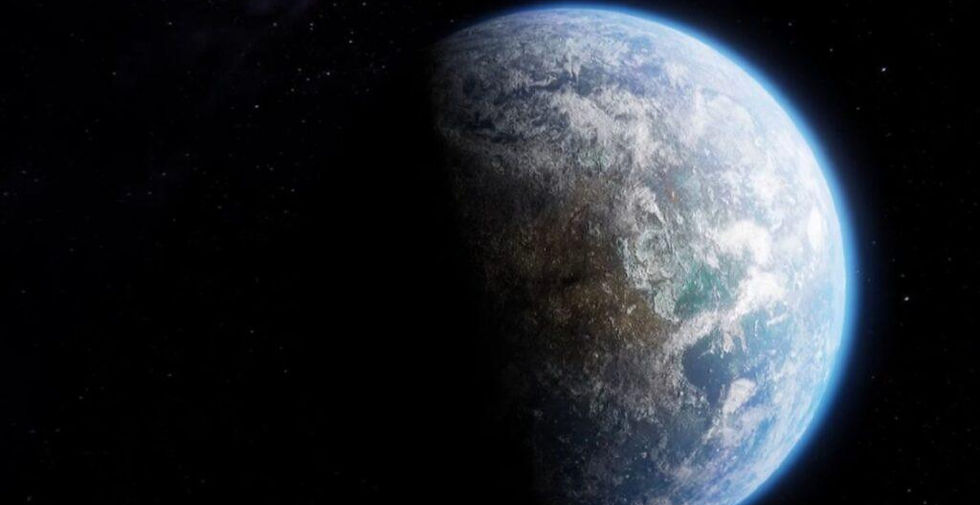
K2-18b: A Hycean Planet in Deep Habitability
K2-18b is an exoplanet classified in the hypothetical category of Hycean planets – a neologism derived from the words " hydrogen " and " ocean ". These are worlds characterized by hydrogen-rich atmospheres and surfaces potentially covered by vast liquid oceans. These conditions make these planets particularly interesting in the search for environments favorable to life, even if profoundly different from Earth.
With a radius 2.6 times that of Earth and a mass of about 8.6 Earth masses, K2-18b orbits a red dwarf star (K2-18) in the so-called " habitable zone " – the region where the temperature is sufficient to sustain stable liquid water. Adding to the intrigue of this world is its relatively low density, which supports the idea of a rocky core covered by a thick atmosphere and potential global ocean.
DMS and DMDS: Molecular Signatures of the Biological Unknown
The discovery is based on the spectroscopic analysis of data obtained using the JWST Mid-Infrared Instrument (MIRI) , which allowed the detection of signals compatible with the presence of dimethylsulfide (DMS) and dimethyl disulfide (DMDS) – organic compounds containing sulfur.
On Earth, DMS is produced almost exclusively by living organisms, especially marine phytoplankton and bacteria that inhabit ocean waters. Its atmospheric detection is therefore considered, in astrobiology, a potential bioindicator , i.e. a molecule whose presence is strongly associated with biological processes.
The research group led by Nikku Madhusudhan of the University of Cambridge has published the preliminary results on the arXiv portal, highlighting that the spectrum obtained cannot be satisfactorily explained without invoking the presence of at least one of these compounds, with a statistical confidence level of 3 sigma (equivalent to a probability of 99.7%).
Caution and rigor: the ongoing scientific debate
As is usual in academia, excitement over a potentially epochal discovery is accompanied by rigorous caution. Ignasi Ribas , an astrophysicist at the Italian National Council for Scientific Research (CSIC), has stressed that "extraordinary claims require extraordinary evidence." Indeed, a significance of 3 sigma, while suggestive, does not reach the canonical level of 5 sigma needed to proclaim a discovery with full authority.
Furthermore, it is reported that DMS can form in abiotic contexts, although with an extremely lower probability: it has been detected, for example, in very small quantities inside cometary materials and in the laboratory through high-energy chemical reactions in hydrogen-rich environments.
The difficulty of interpretation also comes from the complex atmospheric chemistry of K2-18b , still largely unexplored. The interaction between hydrogen, methane, carbon dioxide and sulfur-based compounds could give rise to phenomena unknown on Earth.
Towards a new frontier in the search for life?
If confirmed, this detection would be a turning point : the first concrete trace of biological activity on an extrasolar world. However, further observations are needed, ideally integrated with other next-generation instruments, such as the European Extremely Large Telescope (ELT) or ESA's Ariel mission , dedicated to the atmospheric study of exoplanets.
In addition to chemical analysis, it will be essential to reconstruct climatic and geological models of the exoplanet to understand the stability and depth of the hypothetical ocean and the possible existence of sustainable biochemical cycles.
A cosmic clue that invites humility
K2-18b now stands out as one of the most promising candidates in the race to discover life beyond our planet. The detection of DMS and other potentially biological compounds does not yet amount to definitive proof, but it represents a profound and exciting clue , raising new questions about the universality of life and its potential abundance in the universe.
It is an invitation to scientific humility, but also a push to continue with rigor, imagination and dedication in our cosmic journey in search of other forms of existence.


Comments